
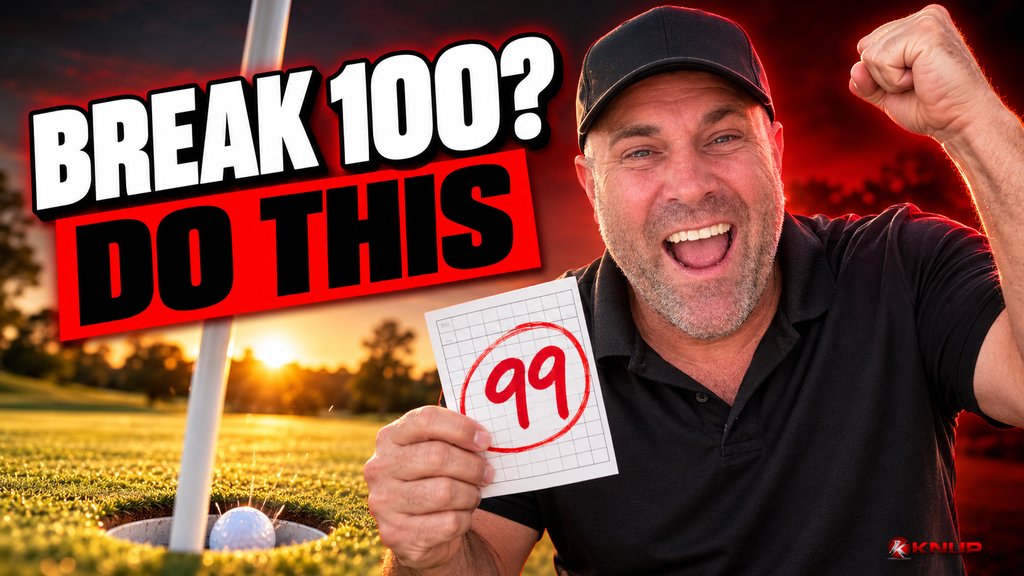
I am not a scratch golfer, and I am not going to pretend to be one. My usual band is somewhere between 95 and 100. When I played Eagle Creek in Lake Nona, I shot a 98 from the yellow tees, 47 on the front and 51 on the back, with one birdie on a par 3.
So this is not a tour pro telling you to "just rotate through it." This is a guy who knows exactly how it feels to stand on the 18th tee doing math in his head, hoping for a bogey to stay under triple digits.
Here is the good news. Breaking 100 does not require you to hit great shots. It requires you to stop hitting the same three or four terrible ones. Let's go.
Do the math first: what breaking 100 actually means
Most courses are par 70 to 72. On a par 72, shooting 99 means you can be 27 over par. That is a lot of room.
Think about it this way:
- 18 bogeys on a par 72 is a 90. You would beat 100 by ten shots without a single par.
- Nine bogeys and nine double bogeys is a 99. That breaks 100.
- You do not need pars. Every par is a bonus, not a requirement.
That changes how you should play. You are not trying to make par on every hole. You are trying to make bogey and avoid the triple, the quad, and the "I'm just going to pick up" hole. One blow-up hole of 9 or 10 can wipe out three good holes.
So the whole game plan below is built around one idea: take the big numbers off your card.
Play from the right tees
This is the easiest strokes you will ever save, and most golfers skip it because of ego.
If the course is too long for you, you are hitting fairway woods and hybrids into par 4s all day. Those are the hardest clubs in the bag to hit straight. Move up a set of tees, and suddenly you have 7-irons and 8-irons in your hands.
The PGA of America and the USGA built a whole program around this called Tee It Forward. Their tee selection guideline chart matches your average driver distance to a course length. For example, if you average about 225 yards with the driver, it suggests an 18-hole course of about 5,800 to 6,000 yards. If you average 200, it is about 5,200 to 5,400.
Be honest about your real average drive, not your best one. Then pick the tees that fit. Nobody at the 19th hole asks which tees you played.
Make your tee shot boring
The tee shot is where most of the disasters start. A ball out of bounds or lost costs you a penalty stroke plus the distance, so you are hitting your third shot from the tee. That is how a bogey hole turns into a 7.
If your driver goes sideways a few times a round, try this:
- Hit the club you trust most off the tee. That might be a 3-wood, a hybrid, or even a 5-iron on a tight hole. Shorter and in play beats longer and in the trees.
- Aim away from the worst trouble. If there is water or out of bounds on the right, aim at the left side of the fairway and accept the rough over there.
- Hit a provisional when you are not sure. If you think your ball might be lost or out of bounds, the Rules of Golf let you play a provisional ball right away. It saves you a long walk back. The R&A has a simple explainer on the lost ball and provisional rules.
A boring tee shot in play is the start of almost every bogey.
Get out of trouble in one shot
You are going to end up in the trees. Everyone around 100 does. What separates a 5 from an 8 is what you do next.
The mistake is the hero shot: threading a 3-iron through a gap the size of a mailbox. It hits a tree, drops behind another tree, and now you are lying three and still in jail.
The rule I try to follow: when you are in trouble, your only job is to get back in play. Chip out sideways to the fairway, even if it feels like you are giving up distance. You are giving up maybe half a shot. The hero shot is risking two or three.
Same thing with fairway bunkers and deep rough. Take enough loft to get it out cleanly. Get it back on the short grass, then start over.
Aim for the middle of the green
At this level, the pin is not your target. The middle of the green is.
When you aim at a flag tucked near a bunker or water, a slight miss puts you in the hazard. When you aim at the middle, a slight miss in any direction is often still on the green or just off it with an easy chip.
A few simple habits help:
- Take one more club than you think. Most amateurs come up short far more than they go long, because they club themselves for their best swing, not their normal one.
- Know where the big miss is. If there is a bunker short and nothing long, err long.
- Lay up to a yardage you like. On par 5s and long par 4s, you do not need to go for it. Leave yourself a full wedge instead of a half shot over a bunker.
Hitting more greens is great. Avoiding the side of the green where the trouble lives is what breaks 100.
Get it on the green from close range
Around the green is where golfers near 100 lose a ton of shots without noticing. Chunked chips, bladed chips across the green, and three tries out of a greenside bunker add up fast.
Keep it simple:
- Putt when you can. If you are just off the green and the grass is short, putt it. A bad putt is usually better than a bad chip.
- Use a basic bump-and-run. A lower-lofted club, like an 8-iron or 9-iron, with a putting-style stroke gets the ball rolling early and is much more forgiving than a high flop.
- Get out of the bunker in one. Do not try to hole it. Just get it on the green, even if it is 30 feet away.
The goal from close range is one chip and two putts at worst. That is how a missed green still turns into a bogey.
Stop three-putting
This one matters more than anything else on this list. Three-putts are pure wasted strokes, and most of them come from the first putt, not the second.
When I looked back at my Eagle Creek round in 18Birdies, it showed I had two other birdie looks and missed both, one short putt and one long one I left short. Leaving a long putt short is exactly how three-putts start.
On long putts, think distance, not line. Your goal from 30 or 40 feet is to get the ball inside a few feet of the hole, so the next one is easy. Picture a circle around the cup and just try to stop it in there.
A quick practice habit before your round helps a lot: hit a few long putts across the practice green and pay attention only to the speed. Then knock in a handful of short ones so you see the ball go in.
If you can turn most of your three-putts into two-putts, you might break 100 without changing anything else.
Never let one hole wreck your round
Golfers who shoot 105 are usually not hitting worse shots than golfers who shoot 97 on every hole. They just have a couple of disaster holes.
A few rules that keep the disaster small:
- Double bogey is not a disaster. If you are in trouble, play for the double and move on. Trying to save par from a bad spot is how doubles become quads.
- After a bad hole, play the next tee shot extra safe. A bad hole followed by an angry swing is how you lose a whole stretch.
- Do not chase a score in the middle of the round. Play one shot at a time and add it up later.
I keep score of everything (I even wrote a whole post about it, I Keep Score of Everything Including Life), so I know how tempting it is to do the math on every tee box. Save it for the end.
Track your rounds so you know where the strokes go
You cannot fix what you are not counting. When you track your rounds hole by hole, you start to see patterns: maybe the driver costs you three shots a round, or maybe it is three-putts, or maybe it is one particular kind of chip.
Start by counting every stroke honestly, including penalties. If you are not sure how, I broke it all down in How to Keep Score in Golf. Then add a few simple stats:
- Penalty strokes per round
- Number of putts per round, and how many three-putts
- How many times you needed more than one shot to get out of trouble
After a few rounds, the biggest leak usually jumps off the page. Practice that one thing first.
A simple game plan for your next round
Here is the whole thing on one card:
- Play the tees that fit your real driver distance.
- Hit the club you trust off the tee, aimed away from the worst trouble.
- In trouble, get back in play in one shot.
- Aim at the middle of the green and take an extra club.
- Putt from just off the green when you can, and get out of bunkers in one.
- On long putts, focus on speed and try to leave it close.
- Play for bogey, accept doubles, and avoid the blow-up hole.
- Count every stroke honestly, then look at where they went.
And one more: play at a good pace. The R&A recommends "ready golf" in stroke play, which just means hitting when you are ready and it is safe instead of waiting on a strict order. Less standing around usually means less overthinking.
Final thoughts
Breaking 100 in golf is mostly a strategy problem, not a swing problem. Play the right tees, keep the ball in play, take your medicine in trouble, aim at the fat part of the green, and stop three-putting. Do those things and the big numbers start disappearing.
I am still in that 95 to 100 band myself, so I am working the same plan every time I tee it up. If you want to see how it plays out on real courses, I rate every course I play, with real rounds and scorecards, in my golf course reviews.
FAQ
What does it mean to break 100 in golf?
Breaking 100 means finishing an 18-hole round in 99 strokes or fewer, counting every swing and every penalty stroke. On a par 72 course, that means you can be up to 27 over par.
Is breaking 100 in golf good?
Yes. Breaking 100 is a common goal for newer and casual golfers, and it is a sign that you are keeping the ball in play and avoiding most blow-up holes. You do not need to make many pars to do it.
How many bogeys can you make and still break 100?
On a par 72, 18 bogeys would give you a 90. You could make nine bogeys and nine double bogeys and still shoot 99. The key is avoiding triple bogeys or worse.
What is the fastest way to break 100 in golf?
For most golfers, the fastest gains come from playing the right tees, using a club off the tee that keeps the ball in play, getting out of trouble in one shot, and cutting down on three-putts. Those changes save strokes without a new swing.
Which tees should I play to break 100?
Choose tees that match your average driver distance. The PGA of America and USGA Tee It Forward guidelines suggest, for example, about 5,800 to 6,000 yards for a golfer who averages around 225 yards with the driver.
Golf course reviews
If you like golf course breakdowns, I rate every course I play, with real rounds and scorecards, over in my golf course reviews.