

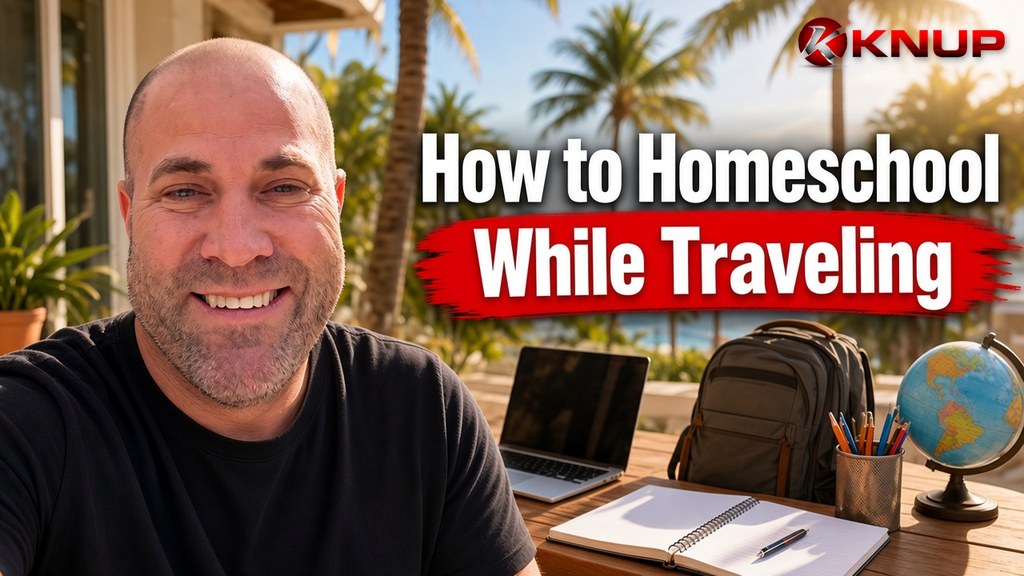
Domains, deals, and podcasts travel well. School has to be designed to travel. Here is how to homeschool on the road without turning every hotel room into a fight over worksheets.
We are aiming for no permanent home starting April 1. When people hear that, the first question is almost never about the businesses. It is about school.
Fair question. We homeschool. Sarah leads Ideal Homeschool, the brand that grew out of real homeschool life in Florida. And the honest answer is that homeschooling while traveling is not a curriculum problem. It is an operating-system problem. The same way the businesses have to be redesigned to travel, school has to be redesigned to travel too.
This is the practical version — what to set up before you leave, how to run a school week on the move, and the traps that make families quit and go home early.
Start with the legal side before the fun side
Travel content loves to skip this part. Do not skip it.
Homeschool rules are set by your state of residence, not by the beach you happen to be sitting on this week. Before you leave, know:
- What your home state requires for notice of intent, records, and annual evaluation
- What "residency" looks like for your family when you no longer have a permanent address
- Whether you need a mailing address, a domicile state, or both
- What records you are expected to keep and for how long
For Florida families, the Florida Department of Education home education page is the primary source, and the law itself is Section 1002.41, Florida Statutes. If you are in another state, HSLDA's state law summaries are a good starting map — then confirm with your state.
Ideal Homeschool is built around "Florida-aware support without pretending every state is the same." That line matters more on the road, not less. Figure out the rules while you still have a kitchen table and a printer.
Decide what "school" means for your family on the road
The fastest way to burn out is trying to recreate a classroom in a rental car.
Before you go, sort learning into three buckets:
- Non-negotiables. The core skills that need steady reps — usually math, reading, and writing. These happen on a rhythm no matter where you are.
- Portable subjects. History, science, geography, and language that can ride along with the trip. A museum, a state park, or a city with a story can carry a lot of this.
- Seasonal extras. Electives and projects that pause during heavy travel weeks and come back during slower stretches.
That split keeps you honest. The non-negotiables protect progress. The portable subjects let the trip actually count. The extras stop being a source of guilt.
Ideal Homeschool's whole approach starts from the idea that families get sold programs when what they really need is "a calmer plan, better questions, and someone who has already walked the year." On the road, a calmer plan beats a bigger box of curriculum every time.
Build a school kit that fits the bag
My test for work gear is brutal: if it does not fit in a backpack and a suitcase, why do I need it? School gets the same test. I wrote about the general version in How to Pack for a Long Trip With Just a Backpack.
A travel school kit usually comes down to:
- One device per learner (or a shared schedule if devices are shared), with downloaded material for bad wifi days
- A small set of physical books — the ones that are genuinely better on paper
- One notebook per subject or one notebook per kid, not a binder system
- Headphones so one person's lesson does not become everyone's background noise
- Cloud storage for work samples, reading logs, and anything you might need for records
If a curriculum only works with a shelf of workbooks, it is a home-base curriculum. That is fine. It just means you either digitize it, swap it, or save it for the slower weeks.
Pick a rhythm, not a perfect schedule
Hotels, Airbnbs, and family guest rooms do not care about your color-coded weekly plan.
What travels better is a rhythm:
- A short morning block for the non-negotiables, before the day gets loud
- An afternoon or evening "trip learning" block tied to wherever you are
- A weekly catch-up window for anything that slipped
This is the same idea as building a morning routine that survives travel. You do not need the same hour every day. You need the same order. When the order holds, the work gets done even when the clock moves.
Travel days are their own thing. Plan them as light days on purpose — audiobooks, reading, a journal entry — instead of pretending a seven-hour drive is a normal school day.
Make the trip part of the curriculum
The whole point of homeschooling while traveling is that the world gets to teach too. Use it.
Simple ways to turn travel into school without a lot of prep:
- Before you arrive: read or watch one thing about the place
- While you are there: one observation, photo, or question per learner
- After you leave: a short write-up, sketch, map, or conversation about what stuck
- Budget and logistics: let older kids help plan a day — costs, routes, timing. That is real math and real life skills.
Field trips do not have to be expensive. A downtown walk, a historic site, a local ballpark, or a nature trail can carry more learning than an overpriced attraction. And sometimes the lesson is just being together in a new place — experiences with your kids beat almost every practical excuse.
Protect work blocks and school blocks at the same time
This is the part nobody puts in the pretty travel reels. When both parents are working remotely and school is happening at the same table, something has to give unless you plan it.
What helps:
- Decide who is "on school" during each block. Two parents half-teaching while answering email is worse than one parent fully on.
- Stack deep work around independent learning time. If a kid can read or do a lesson solo for 45 minutes, that is a work block for you.
- Choose lodging for the work, not just the view. A separate table or room matters more than a pool.
- Have a bad-wifi backup. Downloaded lessons for them, a phone hotspot for you.
We already try to work side by side without turning home into a meeting. On the road, the same rule applies to school: clear lanes, clear blocks, fewer collisions.
Keep records like you might need them
Records are boring. Records are also what makes this sustainable.
A simple system:
- A running log of what was covered each week, even a few lines
- Work samples saved digitally — photos of written work, finished projects, reading lists
- Trip learning notes — where you went and what it connected to
- One folder per school year in cloud storage, not scattered across phones
If your state requires a portfolio or annual evaluation, you will thank yourself. If it does not, the log still shows you what is actually working. I keep score of almost everything — including life — and school is no exception. A scoreboard makes it obvious when a subject has quietly disappeared for three weeks.
Plan for social life and community
One of the real questions about homeschooling on the road is friends and community. Kids need people, not just places.
Ways families handle it:
- Keep core friendships alive with regular video calls or shared online activities
- Plan longer stays in some places so kids can join something local
- Look for homeschool groups and co-ops where you land — many welcome visitors
- Use online communities that match your kids' interests
Small, real communities beat big empty ones. That is true for business, and it is true here. I wrote about the general version in How to Build a Small Online Community.
Audit before you go
Travel does not fix a messy plan. It magnifies it.
Before you leave, run the school version of a life audit before you go location independent:
- Which curriculum and subscriptions are you actually using?
- Which ones only work at home?
- What does each kid need more of — structure, freedom, social time, challenge?
- What will you drop if a week gets hard?
- Who is responsible for what?
Answer those at home. On the road, you will not have the energy to answer them well.
Common mistakes that send families home early
- Overpacking curriculum. More material is not more learning. It is more weight and more guilt.
- Treating every day like a vacation. Fun is great. Zero rhythm for a month is how kids fall behind.
- Treating every day like a school day. The opposite mistake. If the trip never gets to teach, why travel?
- Ignoring the legal side. Easy to fix before you go, stressful to fix from a parking lot.
- No backup for bad wifi. It will happen. Usually on the day you need it most.
- Parents trying to do everything. Clear lanes beat heroic multitasking.
A simple first-month plan
If you are starting soon, do not try to design the whole year. Design the first month.
- Week one: Confirm legal requirements and records. Pick the non-negotiable subjects.
- Week two: Build the bag. Download what you need. Test a full school day with only the travel kit, at home.
- Week three: Run a practice week — rhythm, work blocks, a local "field trip."
- Week four: Review the log. Cut what did not work. Keep what did.
Then go. Adjust from real life instead of theory.
Final thoughts
Homeschooling while traveling is not about finding the perfect curriculum. It is about building a school that can move — legal basics handled, a short list of non-negotiables, a kit that fits the bag, a rhythm instead of a rigid schedule, and records you can trust.
That is the same pattern we are using for the businesses and for life. Fewer anchors. Clearer systems. More time together in places worth being.
If you want help building the plan, start with Ideal Homeschool. Sarah built it for exactly this kind of family: people who want education to be part of life, not a separate product.
A calmer plan that can travel
Sarah built Ideal Homeschool for families who want education to be part of life, not a separate product.