
I am not a golf instructor. I am a regular golfer who usually lives somewhere between 95 and 100, and I have written about how to break 100 in golf because that number is my world.
Here is the thing I keep coming back to at that level. Most of the strokes I lose are not lost on a perfect range mat. They are lost on three-putts, chunked chips, and swings where the club just does not get back to the ball the same way twice. Every one of those can be worked on at home, for free or close to it, on days when getting to a course is not happening.
This post covers how to set up a small practice space, the drills worth your time for putting, chipping, and the full swing, and how to structure short sessions so they actually carry over to the course.
Why practicing golf at home works
The biggest advantage of home practice is not the equipment. It is frequency.
A trip to the range takes a couple of hours once you add the drive, the wait, and the bucket. Most of us cannot do that often. But you can make swings in the living room or roll putts on a mat almost every day. Short, frequent reps build habits faster than one long session a week.
Hank Haney made this point in a Golf Digest piece on why you don't have to go to the driving range to get better. His suggestion was 100 practice swings with an iron every day, no ball needed, even in front of the TV. As Golf Digest put it, 100 swings a day will not have you breaking 80 this weekend, but it is a real step in the right direction.
The second advantage is that home practice removes the ball flight. That sounds like a downside, but it means you stop reacting to every shot and start paying attention to the motion itself.
Set up a simple practice space
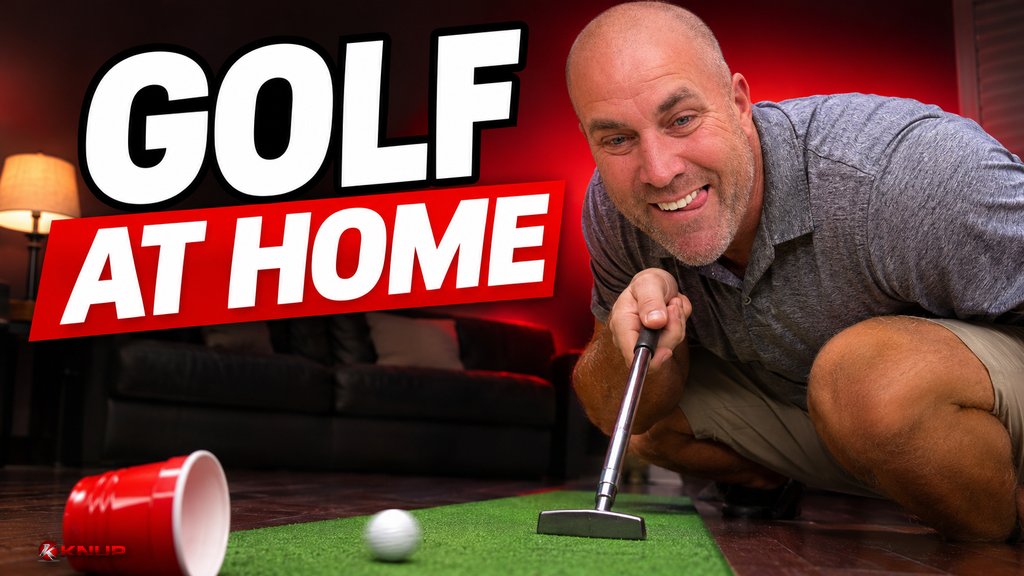
You do not need a dedicated room. The PGA of America's series on how to practice golf at home suggests a small corner of a living room or backyard with a few essentials: a putting mat, a chipping target like a towel or bucket, and a net for full swings if you have the space.
Here is how I would think about it, in order of value:
- A putting surface. A decent putting mat, or a strip of flat, low-pile carpet, is the single most useful thing you can have. Putting is the easiest skill to practice indoors and the one that shows up on every hole.
- Foam or plastic practice balls. These let you chip indoors or in a small yard without breaking anything.
- A towel and a bucket. Free targets for chipping and contact drills.
- Painter's tape or alignment sticks. For marking aim lines, ball position, and where the club should touch the ground.
- A net, if you have room. Optional, but it lets you hit real full shots in a backyard or garage.
Before any full swing indoors, check your ceiling, light fixtures, TVs, and anything breakable in a full circle around you. Make a slow practice swing first so you know the club clears everything. If it is tight, use a shorter club, choke down, or stick to half swings. Your golf game is not worth a broken ceiling fan.
Putting drills you can do on carpet
Putting is where home practice pays off fastest. Three drills cover most of what matters.
The gate drill for start line
Set two tees, coins, or small objects on the mat just wider than your putter head, a few inches in front of the ball. Roll putts through the gate without touching either side. This trains you to start the ball on your intended line, which is the foundation of making short putts. Once it is easy, narrow the gate.
Distance ladders for speed
Most three-putts come from bad speed, not bad reads. Put markers at roughly 3, 6, and 9 feet, or at whatever lengths your space allows. Roll one ball to each distance, then work back down. The goal is not to make putts. The goal is to stop each ball as close to its target as you can.
Practicing to specific distances and targets is how your hands learn what each length of stroke feels like.
Pressure reps from short range
Pick a putt you should make, usually 3 or 4 feet on your mat. Try to make 10 in a row. Miss one, start over. It sounds simple, but by the eighth or ninth putt you will feel some of the same nerves you feel on the course, and that is the point.
If you already track putts per round, this is where home practice shows up in the numbers. I talked about tracking stats like putts in how to keep score in golf.
Chipping drills with foam balls and a towel
Chipping indoors is about two things: clean contact and landing the ball where you mean to.
The towel landing drill
Lay a towel on the floor or in the yard a short distance away and try to land foam or plastic balls on it. Do not worry about where the ball rolls after it lands. You are training your sense of how long a swing it takes to carry the ball a certain distance.
MyGolfSpy's list of short-game drills every golfer should practice at home suggests doing this with different clubs, like a 7-iron, 9-iron, and wedge, so you learn how each one flies and rolls. Light practice balls do not behave exactly like real ones, so focus on the feel of the swing length, not the exact distance.
The lead-hand-only chip
MyGolfSpy also recommends chipping with just your lead hand (the left hand for right-handed golfers). It forces the club to keep moving through the ball instead of flipping at it, which is a common cause of chunks and skulls. Start with very small swings.
Low-point control with tape
Put a strip of painter's tape on the carpet or mat. Make small chipping swings and try to brush the carpet just ahead of the tape, never behind it. Hitting the ground in the same spot every time is the skill that separates crisp chips from fat ones. Once you can do that, place a foam ball just behind the spot where the club brushes.
Full swing drills without hitting a ball
You can do real work on the full swing without a net or a ball. The trick is to go slow and pay attention.
Slow practice swings with an iron
This is a slowed-down version of the Haney drill. Take a mid-iron and make slow, full practice swings, focusing on a good takeaway, keeping control of the clubface, and finishing in balance. Slow swings let you feel positions that disappear at full speed. If 100 a day sounds like a lot, start with 20 and build up.
Swing without a club
Butch Harmon described air swings as something like shadowboxing in Golf Digest's piece on Dustin Johnson's practice without a club. With nothing in your hands, you are not rushing to hit anything, so it is easier to settle into good posture, shift your weight to your lead side, and finish fully rotated and balanced. You can do these anywhere, including a hotel room.
Fix your path with a household object
If you fight a slice, a lot of it comes from an out-to-in swing path. I went deeper on that in how to fix a slice in golf. Golf Digest shared a home drill from teacher Jason Guss in its piece on four at-home drills anybody can do: set an ottoman a couple of feet behind the ball and just outside your swing path, then make slow swings that avoid it on the way down. It trains the club to approach from the inside instead of cutting across.
Use something soft for this. A pillow or a stuffed headcover works if you do not have an ottoman.
Use a mirror or your phone
A mirror or a phone video is the closest thing you have to a coach at home. Check your posture at address, where the club points at the top, and whether you finish balanced. Record a few swings once a week and compare them. You will see things you cannot feel.
How to structure a home practice session
The PGA of America's at-home series lays out a sample session with a warm-up, then putting, chipping, full swing work, and a short cool-down. That is a good full session if you have an hour.
Most days, you will not. Here is a shorter version that fits real life:
- Two or three minutes of loosening up. Light stretching and a few slow air swings.
- Five minutes of putting. One drill, like the gate drill or a distance ladder.
- Five minutes of chipping or low-point work. Towel landings or the tape drill.
- Three to five minutes of slow full swings. One focus only, like posture or path.
That is 15 to 20 minutes. The key is picking one goal per drill and keeping score of something, like how many putts you made through the gate or how many chips landed on the towel. Practicing with a purpose is what turns reps into improvement.
If you can only do one thing, putt. It is the easiest to set up, the easiest to measure, and it saves strokes on every hole.
Common mistakes when practicing golf at home
A few things will quietly waste your time:
- Practicing too fast. Full-speed swings in a small room are risky and usually sloppy. Slow it down.
- Doing everything at once. One drill done well beats five drills done halfway.
- Never measuring. If you do not count anything, you cannot tell if you are getting better.
- Ignoring safety. Check ceilings, lights, windows, people, and pets before every session.
- Only practicing what you are already good at. If chipping costs you strokes, it gets the time, even if putting is more fun.
Final thoughts
Getting better at golf does not require a lot of money or time. It requires reps, and home practice is the easiest way to get them. A mat, a towel, some tape, and a club you can swing slowly will cover most of what a mid-handicap golfer needs.
Start with 15 minutes a few days a week, keep score of your drills, and take what you learn to the course. Then go play. If you are looking for somewhere to tee it up, check out my golf course reviews.
FAQ
Can you really get better at golf by practicing at home?
Yes. Putting, chipping contact, and swing mechanics can all be improved at home with short, frequent sessions. You will still want time on a course or range to test it with real ball flight, but home practice builds the habits that show up there.
What is the best way to practice putting at home?
Use a putting mat or flat carpet and focus on start line and speed. The gate drill trains your start line, a distance ladder at roughly 3, 6, and 9 feet trains speed, and trying to make 10 short putts in a row adds a little pressure.
Can I practice chipping indoors?
Yes, with foam or plastic practice balls. Land them on a towel to train distance control, try one-handed chips with your lead hand to stop flipping, and use painter's tape to practice brushing the floor in the same spot every time. Clear the area of anything breakable first.
How can I practice my golf swing at home without hitting balls?
Make slow practice swings with an iron, rehearse your swing without a club to focus on posture and balance, use a soft object outside your path to train an inside swing path, and check your positions in a mirror or on phone video.
How long should I practice golf at home each day?
Even 15 to 20 minutes helps if it is focused. A short session of putting, chipping, and a few slow full swings with one goal each is more useful than a long session without a plan.
Golf course reviews
If you like golf course breakdowns, I rate every course I play, with real rounds and scorecards, over in my golf course reviews.