
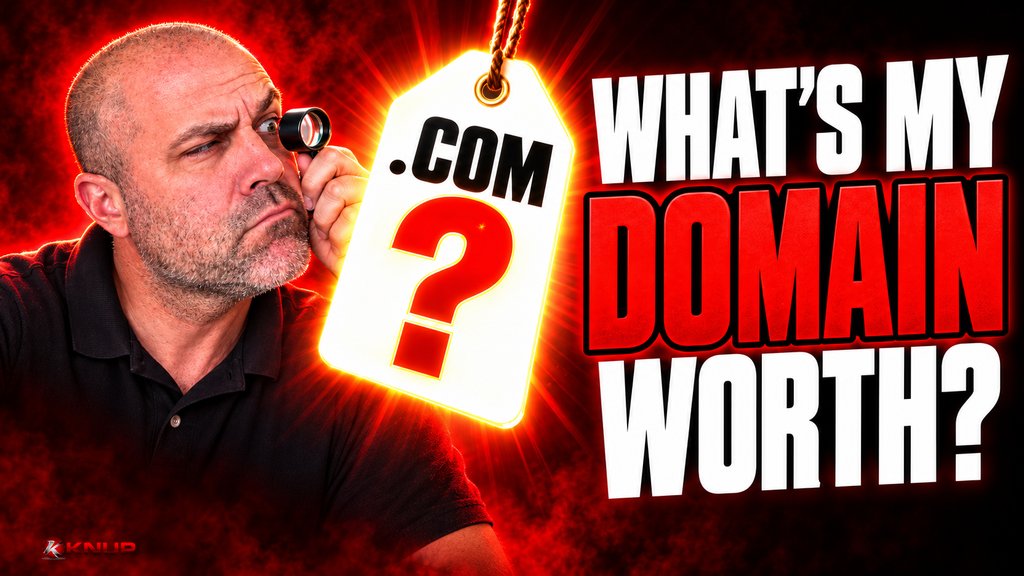
"What is this domain worth?"
I get that question a lot. Sometimes it is a friend who registered a name years ago and forgot about it. Sometimes it is someone who just got an email offer and wants to know if they are being lowballed. Sometimes it is me, staring at a renewal notice and trying to decide if a name still earns its spot.
The honest answer is that a domain is worth what a real buyer will pay for it. Not what an appraisal tool says. Not what you paid. Not what you hope.
But you can get a lot closer than guessing. At one point I owned more than 1,600 domains. I am down to about 200 now and still cutting. I have sold names, built on names, and dropped a lot of names I should never have registered. I tell that whole path in How I Got Into Domains. Every one of those decisions was really a valuation question.
This is the process I use now to figure out how to value a domain name.
Start with the question: worth it to whom?
A domain does not have one value. It has a few.
- Retail value is what an end user, usually a business that wants that exact name, might pay. This is the big number people dream about.
- Wholesale value is what another domain investor would pay. Investors are buying inventory to resell, so this number is much lower.
- Use value is what the name is worth to you if you build on it.
- Drop value is zero. That is what it is worth if nobody wants it and you stop renewing.
Most "my domain is worth thousands" stories mix these up. A name can have real retail potential and almost no wholesale value, because an investor knows it could sit for years before the right buyer shows up.
So before you put a number on anything, decide which value you are asking about. If you are selling fast, think wholesale. If you are willing to wait for the right business, think retail. If you are deciding whether to keep it, think use value against the renewal bill.
Run the quality test first
Nothing else matters if the name itself is weak. I run every name through the same basic standards I use when picking a domain name for a new business:
- Extension. .com is still the default people type and trust. A true one-word name in another extension can work, but a weak phrase on a weak extension is rarely worth much.
- Length. One or two words. Short beats long almost every time.
- No hyphens, no numbers. Both break when someone says the name out loud.
- Say it once. If you tell someone the name over coffee, can they type it correctly later? If you have to spell it twice, the value drops.
- Clear meaning or a strong brand feel. Either it describes something people actually search for, or it sounds like a company someone would want to be.
- Commercial intent. Is there an industry with money behind the words? A name in a space full of businesses has more potential buyers than a clever phrase nobody sells anything around.
If a name fails two or three of these, I do not need an appraisal. It is a drop or a cheap hold.
Check for trademark problems before you dream
This is the one I learned the hard way. Back in the Celebrity Club Network days I built fan sites on celebrity names and got cease and desist letters from Miley Cyrus and Barry Manilow. I wrote about it in Why I Avoid Athlete, Team, and Event Domains Now.
A name that leans on someone else's brand is not an asset. It is a liability with a renewal date. If the value depends on a famous company, person, team, or event, the real value to you is close to zero, and it can cost you the name entirely through a dispute under ICANN's Uniform Domain-Name Dispute-Resolution Policy.
A quick search of the USPTO trademark database will not make you a lawyer, but it will catch the obvious problems before you get attached to a number.
Measure scarcity: how many close cousins are still available?
This is the step most people skip, and it is one of the most useful.
If you own a two-word .com, look up the obvious neighbors. Swap the order of the words. Try synonyms. Try the same idea in the same niche. I use Instant Domain Search for this because it shows quickly whether names are available or taken.
Then read the results honestly:
- Most of the neighbors are taken. That is strong scarcity. Other people saw value in this pattern and are holding it. That supports a higher value.
- Most of the neighbors are available. That is weak scarcity. If a buyer can register a close version for a normal registration fee, they are not going to pay you a premium for yours.
I check somewhere around 10 to 30 comparable names before I make a keep or drop call on a name I am unsure about.
One rule keeps me honest: scarcity amplifies a good name, but it does not rescue a weak one. A clunky three-word phrase is still clunky even if a few people registered similar ones.
Look up real comparable sales
Appraisals guess. Sales history shows what someone actually paid.
The best free place to start is NameBio, a searchable database of reported domain sales. Search for names with the same keyword, the same length, the same extension, or the same pattern as yours. DN Journal also publishes reported sales charts and industry news.
When you look at comps, keep a few things in mind:
- Match the pattern. A one-word .com sale tells you nothing about your three-word .net.
- Look for clusters, not outliers. One huge sale in a niche does not set the market. Ten sales in a similar range do.
- Remember the gaps. Many private sales are never reported, and reported sales lean toward the names that did sell. The names that sat unsold for ten years do not show up in any database.
- Check the dates. A niche that was hot five years ago may not be hot now.
This is where my own history helps. During the early years of legal US sports betting, a lot of names in my gambling portfolio sold. That market was real, and the comps from that window were real. But I also kept registering bet-plus-word combinations long after the best ones were gone, and plenty of those never sold. A hot niche raises the value of the best names in it. It does not make every name in it valuable.
Use appraisal tools as a gut check, not a price
Automated appraisals are everywhere. EstiBot is one of the better-known tools, and registrars like GoDaddy offer free appraisals too.
They are useful for one thing: a rough signal. They look at things like keyword search volume, length, extension, and comparable sales, and they spit out a number.
They are not useful as a price. Automated numbers can be far too high on long keyword phrases and far too low on short brandables. If an appraisal says your name is worth a lot, that is not an offer. Nobody has to pay it.
I treat an appraisal like a weather app. It is worth glancing at. I still look out the window.
Think about who would actually buy it
Retail value only exists if you can picture the buyer.
Ask yourself:
- Who already operates in this space? Make a list of businesses that use these words in their name or sell this product.
- Is there someone on a worse version of this name? A company on the longer, hyphenated, or non-.com version is your most likely buyer. They already feel the pain.
- Is the industry growing? New money entering a space means new companies that need names.
- Could a startup brand on it? Short brandable names have a wider pool because they are not tied to one niche.
If you cannot name a single realistic buyer, the honest value is closer to wholesale, even if the name looks good on paper.
Add in age, traffic, and history
A few extra factors can push value up or down:
- Type-in traffic. Some names get visits just because people type them in directly. That can add value, especially if you can show the numbers.
- Backlinks and past use. A name with a clean history and real links from a previous site can be worth more to someone building on it. A name with a spammy past can be worth less.
- Age. Older registrations are not automatically valuable, but a long-held name in a strong pattern is a small plus.
- Existing revenue. If a site on the domain earns money, you are valuing a business, not just a name. That is a different conversation.
Do the renewal math on your own names
Valuing a name is not just about selling. It is also about deciding whether to keep paying for it.
I wrote about this in The Real Cost of Owning Too Many Domains. The renewal fee is the visible cost. The bigger cost is attention: names you keep "just in case" that never get built or sold.
Here is a simple way to think about it. If you have held a name for years, never received a real offer, and cannot name a buyer, the market is giving you an answer. Renewing it again is a bet that the answer will change. Sometimes that bet is worth it. Usually it is not.
When I sort my own portfolio, every name goes into one of four buckets: build, sell, keep as a real asset, or drop. If a name cannot defend itself in one sentence, it is on probation.
How to set a price once you have the facts
Once you have run the steps above, you can set a range that you can actually defend.
- Start with comps. Find the range of reported sales for names that match your pattern.
- Adjust for quality. Is your name shorter, cleaner, and more brandable than the comps, or weaker?
- Adjust for scarcity. Strong scarcity moves you toward the top of the range. Weak scarcity moves you down.
- Decide your timeline. Need to sell soon? Price closer to wholesale. Willing to wait? You can hold for a retail buyer.
- Set a floor. Know the lowest number you would accept before an offer arrives, so you do not decide in the moment.
When a deal happens, use an escrow service like Escrow.com or a marketplace's built-in checkout so both sides are protected. I keep my portfolio at Dynadot, which makes transfers straightforward when a sale closes.
Common domain valuation mistakes
- Pricing by what you paid. The market does not care about your cost.
- Pricing by emotion. A name you love is not automatically a name someone else will pay for.
- Treating an appraisal like an offer. It is a guess, not a check.
- Ignoring available cousins. If buyers can get something nearly as good for a normal registration fee, your premium disappears.
- Ignoring trademarks. A name that rides someone else's brand can be lost entirely.
- Holding forever by default. No offers in years is data, not bad luck.
Final thoughts
Learning how to value a domain name is mostly about being honest with yourself. Run the quality test. Check for trademark trouble. Measure scarcity. Look at real sales. Picture a real buyer. Then set a range you can defend.
I spent years learning this by renewing names I should have dropped. A smaller set of names you can explain beats a big pile of maybes.
If you are looking for a name that already made my cut, you can browse the Knup domain portfolio or ask about a specific name.
FAQ
How do I find out what my domain name is worth?
Start by checking quality (extension, length, clarity, and commercial use), then look for available close variations to measure scarcity, then search reported sales on a site like NameBio for names with the same pattern. Use automated appraisals only as a rough signal. The real value is what a realistic buyer would pay.
Are free domain appraisal tools accurate?
They are useful as a rough gut check, but they are not prices. Automated tools often overvalue long keyword phrases and undervalue short brandable names. Treat the number as a starting point and confirm it with comparable sales.
What makes a domain name valuable?
Short length, a .com or a strong one-word name in another extension, easy spelling, clear meaning or a strong brand feel, real commercial demand, and scarcity, meaning close variations are already taken. A clean trademark picture matters too.
Is an old domain worth more?
Age alone does not make a name valuable. A long-held name in a strong pattern, with clean history, real backlinks, or type-in traffic, can be worth more. A weak name that is simply old is still a weak name.
Should I sell my domain or keep renewing it?
If you have a clear use for it or real buyer interest, keep it. If you have held it for years with no offers, cannot name a likely buyer, and are not building on it, dropping it or pricing it to sell is usually the smarter move.
A name you can explain
Browse the Knup domain portfolio, or ask about a specific name.