
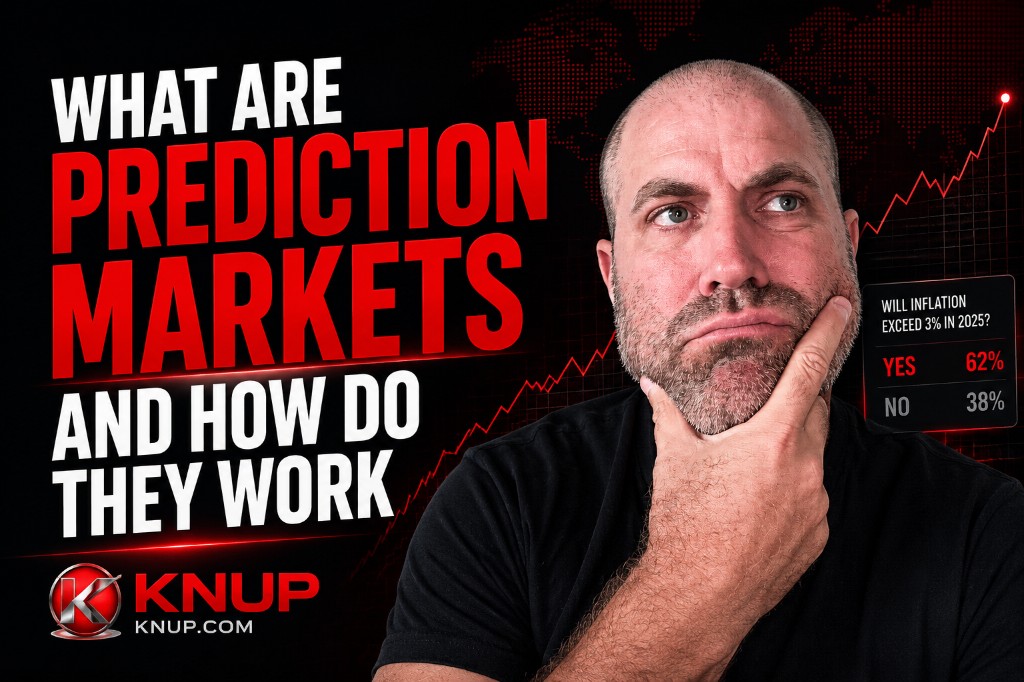
A prediction market is a place where people trade on the outcome of a future event. The price of each outcome becomes a live estimate of how likely that outcome is.
If that sounds familiar, it should. Anyone who has followed sports odds already understands the core idea. A number moves when new information hits. Money flows toward what traders believe is more likely. The market updates in public.
I have spent a long time around sports betting and sports content in the US. Prediction markets feel less like a brand-new invention and more like the next chapter in how Americans price uncertainty. This post explains what they are, how they work, and how they fit into the broader betting timeline.
What is a prediction market?
In simple terms, a prediction market lets people buy and sell contracts tied to a future event. The event can be political, economic, sports-related, entertainment-related, or almost anything with a clear settlement rule.
Example questions look like this. Who wins an election? Will inflation hit a certain level? Does a team make the playoffs? Will a product launch by a set date?
Each possible answer has a price. As people trade, those prices rise and fall. A higher price usually means the market sees that outcome as more likely. A lower price means less likely.
That is the whole loop. Question. Contracts. Trading. Price discovery. Settlement when the real-world result is known.
How do prediction market prices work?
Most beginner explanations use a simple probability frame. If an outcome is priced near 60 cents on a dollar-style contract, the market is roughly saying there is about a 60% chance that outcome happens. If it jumps to 75 cents, the crowd is saying the chance looks higher.
That is not magic. It is supply and demand. People who think a price is too low buy. People who think a price is too high sell. The trade-off between those views creates the live number you see.
Important detail: a market price is not a guarantee. It is a live estimate based on the people trading, the information they have, and how much money is involved. Thin markets can swing hard. Deep markets usually move with more confidence.
If you already understand moneylines, spreads, and totals, you already have the right mental model. Prediction markets just apply similar pricing logic to a wider set of questions.
How this grew out of sports betting in the US
To understand prediction markets in America, it helps to walk the sports betting progression.
For a long time, US sports betting lived in a few legal hubs and a much larger informal market. Odds were the language. Sharp money and public money pulled lines around. Information moved through books, handicappers, media, and word of mouth.
Then came the growth of online sports content. Previews, injury reports, betting explainers, and data-driven coverage made odds part of mainstream sports media. Fans started reading price movement the way they read box scores. Content and betting culture started overlapping more each year.
Fantasy sports and daily fantasy also mattered. Millions of people got comfortable putting money behind projected outcomes, lineups, and probabilities. That trained a larger audience to think in percentages, ranges, and expected value, even if they never used those exact words.
After the Supreme Court struck down PASPA in 2018, legal sports betting expanded across many US states. Apps, media partners, and retail books made wagering more visible. Odds became everyday conversation for a much bigger group of fans.
Prediction markets sit downstream of that shift. Once a large audience understood that a price can represent a probability, it was a shorter step to trade on elections, Fed decisions, awards shows, and other real-world events. Same instinct. Broader scoreboard.
Prediction markets vs traditional sports betting
They are related, but not identical.
Traditional sportsbooks usually set and manage a line, then take the other side of customer action with risk controls. Prediction markets are often framed more like exchanges or event contract venues where participants trade against each other and the price is discovered through that trading.
Sportsbooks are built around games, props, and betting products fans already know. Prediction markets can cover sports, but they also cover politics, economics, culture, and current events.
From a user point of view, the skill overlap is real. Can you process news quickly? Can you avoid overreacting? Can you tell the difference between a real information edge and a loud narrative? Those questions matter in both worlds.
From a content point of view, the overlap is real too. Good explainers, clean data presentation, and honest framing help people understand what a number means. That is the same job sports media has done with odds for years.
A live example helps more than a textbook
Definitions are useful. Watching a live market is better. On the right side of this page is a live widget for the 2028 US presidential election winner market. Watch how candidate prices sit relative to each other, then notice how those prices can shift when major news hits.
That sidebar example is a practical way to see prediction markets in motion instead of only reading about them. If you want to explore more live events beyond this one race, you can browse markets at PredictionMarkets.us.
How to read a prediction market without getting lost
Start with the question. Make sure you understand exactly what wins and what does not. Settlement rules matter. Vague wording creates confusion.
Next, look at the price as a probability estimate, not a scoreboard trophy. A 65% outcome can still lose. A 20% outcome can still win. The number is about chance, not destiny.
Then ask what might move the market. Polls. Debates. Economic data. Injuries. Court rulings. Product news. Whatever the event is, identify the information that should matter.
Finally, check whether the market looks active. More participation usually means a more useful signal. Quiet markets can be interesting, but they can also be jumpy and less reliable as a public read.
Why people use prediction markets
Some people trade them. Some people just watch them. Both uses are common.
As a research tool, prediction markets can act like a live dashboard for public expectations. Instead of waiting for the next weekly poll dump or expert panel, you can see how the crowd is pricing an outcome right now.
As a media tool, they give writers and operators a clean way to show uncertainty. Instead of saying “this looks likely,” you can point to a market price and explain what changed.
As a betting-adjacent tool, they give fans another way to engage with events they already follow. That is one reason the category feels familiar to people who grew up around sports odds and sports content.
Common beginner mistakes
Treating price as certainty. A high price is not a lock.
Ignoring the rules. If you do not know how the market settles, you do not know what you are looking at.
Chasing every headline. Not all news deserves a full reprice. Markets overreact too.
Confusing entertainment with edge. Following markets can be fun and educational. That does not automatically mean every trade is smart.
Forgetting context. Compare markets with other information sources. Polls, fundamentals, injury reports, and historical base rates still matter.
Where this fits in the Knup world
Knup has always lived at the intersection of sports, media, systems, and digital products. Prediction markets sit comfortably in that mix because they combine event storytelling with live pricing.
If you follow our sports hub or pieces like the Home Run Derby preview, you already see how event coverage and probability thinking show up together. Prediction markets are another layer of that same habit: watch the event, watch the number, explain the gap between narrative and price.
Final thoughts
Prediction markets are not mysterious once you strip away the jargon. They are public markets for future events. Prices move as information moves. The US audience was prepared for them by decades of sports odds culture, fantasy growth, content around betting, and legal market expansion after PASPA.
If you are new, start by reading one live market carefully. Understand the question. Watch the prices. Ask what would change your mind. That single habit will teach you more than any buzzword-filled explainer.
Want help building media and systems around live data?
Knup helps operators and brands build cleaner websites, content systems, and conversion paths around sports, media, and digital products.