
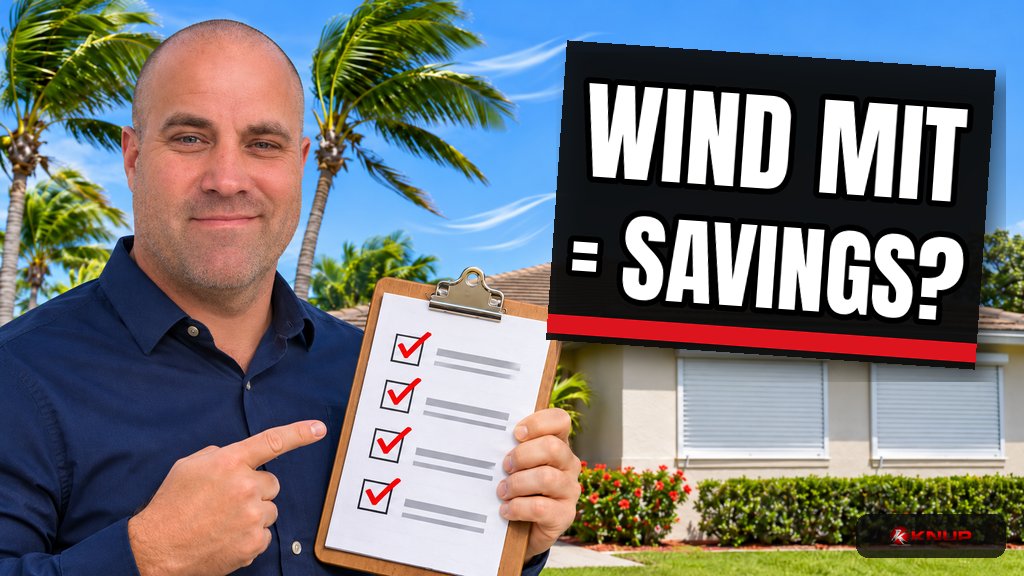
If you're buying a home in Florida, someone is probably going to say "wind mit" to you. It's easy to nod along without knowing what it means.
Here's the short version. A wind mitigation inspection is a report that tells your insurance company how well your home is built to handle wind. The better the features, the more discounts you may qualify for.
I already wrote What Is a 4-Point Inspection in Florida, which is about whether an insurer will cover an older home at all. This is the other side of the coin: what you might save once you're covered.
Quick note before we start: I'm a Realtor, not an insurance agent, inspector or contractor. Every insurer prices its own discounts, and the rules and forms change. Use this to ask better questions, then get the final word from your insurance agent and a licensed inspector.
What is a wind mitigation inspection?
It's an inspection of the features that reduce damage in a windstorm. Think roof shape, how the roof deck is nailed down, how the roof is tied to the walls, and whether your windows and doors are protected from flying debris.
The inspector records it on a state form, the Uniform Mitigation Verification Inspection Form (OIR-B1-1802). You give the completed form to your insurance agent, and the insurer uses it to decide which wind credits apply. It doesn't grade the house. It's a fact sheet about construction features, backed by photos and documents.
Why Florida insurers have to offer wind discounts
This isn't a favor from insurers. It's state law. Section 627.0629 of the Florida Statutes requires residential property rate filings to include actuarially reasonable discounts, credits or other rate differentials, or appropriate reductions in deductibles, for homes with features shown to reduce windstorm losses. The law lists things like roof strength, roof covering performance, roof-to-wall strength and opening protection. Since October 1, 2023, insurers also have to describe their hurricane mitigation discounts on their websites.
There's a companion law too. Section 627.711 requires insurers to tell you about available mitigation discounts when a policy is issued and at every renewal. That's the "Notice of Premium Discounts for Hurricane Loss Mitigation" in your renewal packet.
The state's notice form makes two things clear. These discounts apply to the hurricane-wind portion of your premium, not the whole bill. And they don't simply stack. When one is applied, others are reduced, up to the insurer's maximum.
I'm not going to quote you a savings number. It varies by insurer, location and home. Your agent can run real numbers once they have your form.
The wind mitigation form, section by section
According to the Florida Department of Financial Services' mitigation page, the Office of Insurance Regulation approved a new version of the form, OIR-B1-1802 (Rev. 04/26), and it must be used for all inspections as of April 1, 2026. DFS says it adds categories and spells out the documentation needed for each answer. Inspections done before April 1, 2026, may use the older Rev. 01/12 form.
The current form has nine questions. Here they are in plain English.
1. Building code
Which version of the Florida Building Code was in force when the home's original permit was applied for. There are answers for the 2001 and 2004 code, the 2007 code and later, and the South Florida Building Code for the High-Velocity Hurricane Zone (Miami-Dade and Broward). Homes built around code change years need the permit application date.
2 and 3. Region and roof slope
Where the home sits based on design wind speed, and whether the main roof is steeper or flatter than a 6:12 pitch.
4. Roof covering
The type of roof covering, with a permit application date or a Florida Building Code or Miami-Dade product approval number, plus the year it was installed or replaced.
5. Roof deck attachment
How the plywood or OSB sheathing is fastened to the trusses or rafters, based on nail size and spacing. The form asks for the weakest attachment, not the best.
6. Roof-to-wall attachment
How the roof framing is tied to the walls. Options run from toenails (nails driven at an angle) to clips, single wraps, double wraps and structural. Again, it's the weakest connection.
7. Roof geometry
The roof shape. A hip roof slopes down on all sides. The form counts it as hip if no other roof shapes make up more than 10 percent of the total roof perimeter. Most other roofs are "other."
8. Secondary water resistance
Also called a sealed roof deck. It's an extra layer to keep water out if the roof covering blows off. The form says standard underlayment or hot-mopped felt doesn't count.
9. Opening protection
How well the windows, doors, sliding glass doors, skylights and garage doors are protected from wind-borne debris. Weakest link again, and the form says homes with openings that need replacement don't qualify for wind mitigation rate differentials.
The form says at least one photo or document has to back up each answer in questions 2 through 9. A FORTIFIED Home certificate can be used for some of them.
What happens during the inspection
The inspector looks at the outside, the roof and the openings, then goes into the attic to check the deck nailing and roof-to-wall connections. Citizens Property Insurance says attic access is required to verify certain features, and if the inspector can't get in, you may not be eligible for discounts on roof-to-wall attachment, roof deck attachment and secondary water resistance. Clear a path to the attic hatch before the inspector shows up.
Citizens also suggests handing the inspector any mitigation documents up front, like roofing permits, receipts with product specs, invoices and product approval letters. They help you get credit for features that are hard to see.
Who can sign a wind mitigation form?
Under section 627.711, and as the form lists, insurers have to accept a form signed by:
- A licensed home inspector who has completed at least 3 hours of hurricane mitigation training approved by the Construction Industry Licensing Board and passed a proficiency exam
- A certified building code inspector
- A licensed general, building or residential contractor
- A licensed professional engineer
- A licensed professional architect
Insurers can also accept forms from others they recognize as qualified. DFS says the signer generally has to inspect personally, though licensed contractors and engineers can use a direct employee.
Look up any inspector's license on MyFloridaLicense.com before you hire them. Citizens says a form may not be accepted if the license isn't active or can't be verified, and DFS says insurers can pay to have a form independently verified.
How long is a wind mitigation inspection good for?
Up to five years. The DFS page and the form both say so, as long as no material changes have been made to the structure and no inaccuracies are found on the form.
Watch the "material changes" part. A new roof, windows or shutters are exactly the changes that could make a new inspection worth it.
What does a wind mitigation inspection cost?
I couldn't find an official state source with a typical price, so I won't make one up. Prices vary by inspector, area and home. Ask whether an inspector will bundle it with your home inspection and 4-point, and get a few quotes.
When to get a wind mitigation inspection
- You're buying a home. Get it during your inspection period so your insurance quote reflects the home's real features.
- You replaced the roof. A new roof can change several answers on the form. Citizens suggests asking your roofer about wind mitigation features like secondary water resistance.
- You added shutters, impact windows or doors. Opening protection is judged by the weakest opening.
- You're switching insurers or shopping your renewal. Ask whether your form is on file and still valid.
- You've never had one. Some homes have qualifying features nobody ever documented.
How it fits with the 4-point and home inspection
When you're buying, you'll usually hear about three inspections:
- Home inspection: for you. It covers the whole house so you can negotiate.
- 4-point inspection: for the insurer. Can they cover the home at all based on the roof, electrical, plumbing and HVAC?
- Wind mitigation inspection: for the insurer too, but about discounts.
It often makes sense to book all three with one licensed inspector, early in the inspection period. I walk through the full timeline in How to Buy a House in Florida.
Ask the seller for an existing report
One of the easiest wins in a Florida purchase. If the seller had a wind mitigation inspection in the last five years, ask for a copy. If nothing material has changed, your agent may be able to use it right away. Confirm the form version, date and inspector license will be accepted.
If you're selling, a recent wind mit is a nice thing to hand buyers. More on that in How to Prepare Your House to Sell in Florida. A good agent should bring it up, which is one reason to read How to Choose a Real Estate Agent.
What about My Safe Florida Home?
My Safe Florida Home is a Department of Financial Services program. Its website, mysafeflhome.com, says it offers free wind mitigation inspections and grant assistance for approved hardening upgrades, with grants of up to $10,000 for eligible homeowners.
Timing note: the program's support center says the applicant portal became temporarily unavailable starting November 10, with an enhanced portal expected to launch December 4. Rules, funding and eligibility can change, so check the official site before you count on it.
My simple wind mit checklist for buyers
- Ask the seller for any wind mitigation report from the last five years, plus roof, window and shutter permits or receipts.
- Call your insurance agent early and ask what they need to apply discounts.
- Book the wind mitigation with your home inspection and 4-point, using a licensed inspector you've looked up on MyFloridaLicense.com.
- Make sure the attic is accessible and any stored shutters are easy to find on inspection day.
- Send the completed form to your insurance agent the day you get it and compare quotes.
- Keep a copy with your insurance policy, as the form instructs.
Final thoughts
A wind mitigation inspection is one of the few Florida insurance steps that can work in your favor. State law requires discounts for wind-resistant features, and this form is how you prove your home has them. Get one when you buy, get a new one after big upgrades, and keep a copy handy. If you're buying in Central Florida and want help keeping all these inspections straight, you can find me on my Florida Realtor page. And once you close, don't forget How to File for Homestead Exemption in Florida.
FAQ
What is a wind mitigation inspection in Florida?
An inspection that documents features that reduce windstorm damage, like roof shape, roof attachment, secondary water resistance and opening protection, on state form OIR-B1-1802. Insurers use it to apply wind mitigation discounts.
Do Florida insurance companies have to give wind mitigation discounts?
Yes. Florida Statute 627.0629 requires residential property rate filings to include discounts, credits or deductible reductions for proven wind-loss features. How much you save depends on the insurer and your home.
How long is a wind mitigation inspection good for in Florida?
Up to five years, according to DFS and the form, as long as no material changes have been made to the home and no inaccuracies are found.
Who can do a wind mitigation inspection in Florida?
A licensed home inspector with the required hurricane mitigation training, a certified building code inspector, a licensed general, building or residential contractor, an engineer or an architect. Insurers can also accept others they consider qualified.
What is the difference between a wind mitigation and a 4-point inspection?
A 4-point looks at the roof, electrical, plumbing and HVAC to help an insurer decide whether to cover the home. A wind mitigation documents wind-resistant features that may earn discounts. Ask your inspector about doing both in one visit.
Can I use the seller's wind mitigation report?
Often, if it's within five years and nothing material has changed. Confirm with your insurance agent before you skip ordering your own.
Buying or moving in Central Florida?
I help buyers and sellers think through costs like homestead and property taxes. Start on my real estate page or book a real estate discovery call.